
Biology µGCSE:Yeast
10 quick questions - for GCSE and iGCSE
|
10 minutes maximum! Can you do it in 5? |
|||||||||||||||||||||
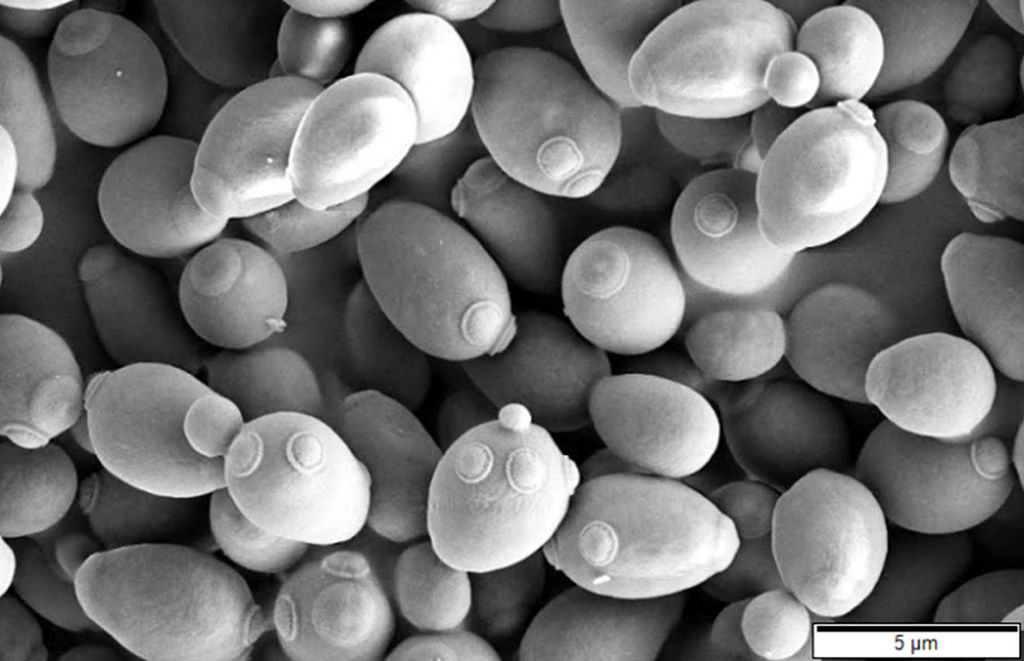
1-3. The image is of yeast, Saccharomyces cerevisiae, which is used in the production of food, e.g. bread. A scale is shown in the botoom right corner of the image.
|
Materialscientist | CC 3.0 | ||||||||||||||||||||
1. Approximately how long is one yeast cell?
| |||||||||||||||||||||
2. Yeast belongs to which kingdom?
| |||||||||||||||||||||
3. Which gas released by yeast helps bread to rise?
| |||||||||||||||||||||
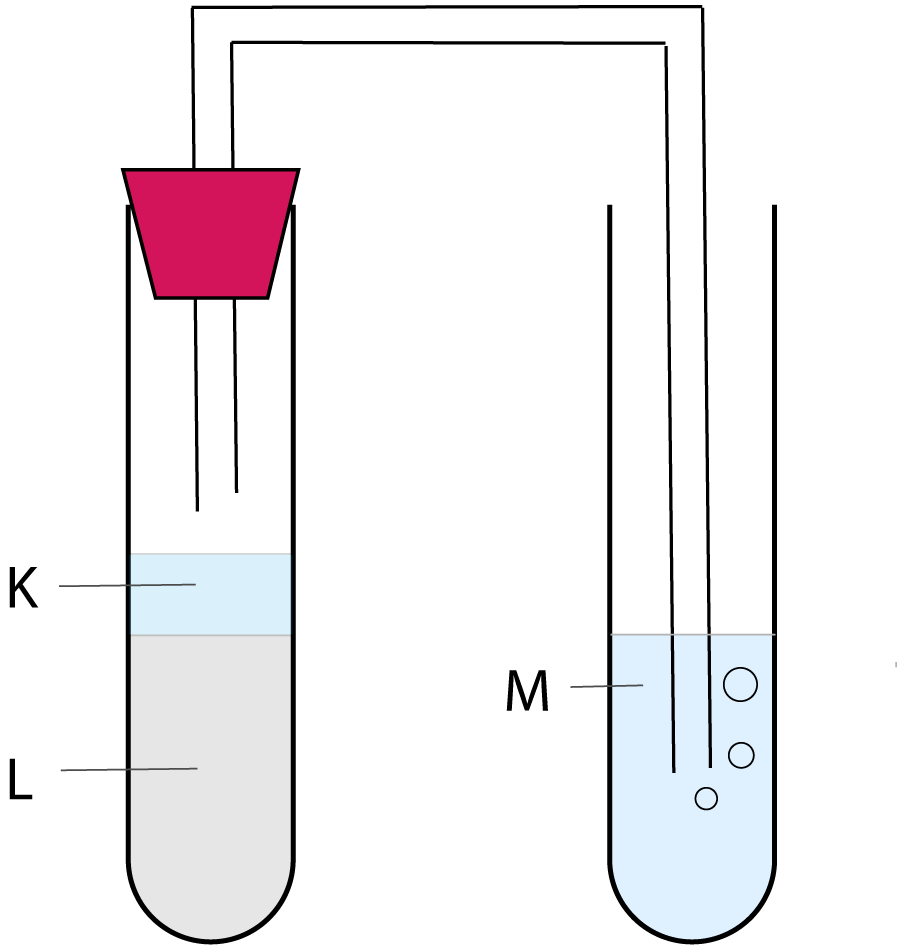
| 4-6: A class of students wanted to investigate the optimum temperature for yeast when making bread. The students set up the apparatus shown in the diagram. They measured the rate of fermentation at different temperatures by placing the apparatus in thermostatically controlled water baths.
|
|||||||||||||||||||||
4. Which of the following are the correct labels for K and L?
| |||||||||||||||||||||
| 5. The students used a liquid, M, to check that the gas produced was carbon dioxide.
Liquid M is..
| |||||||||||||||||||||
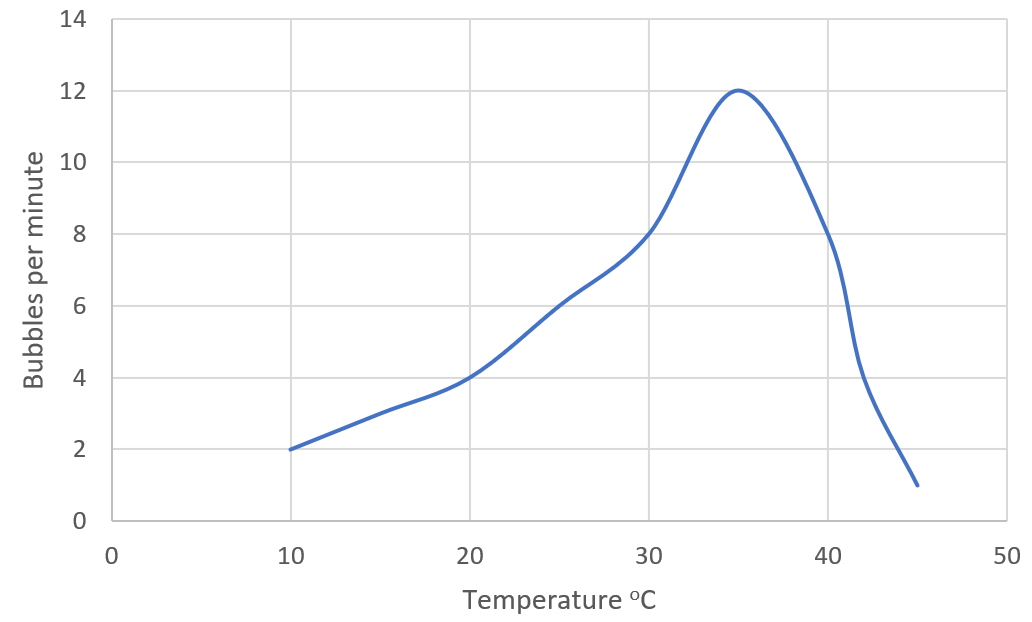
6. The graph shows the mean bubbles per minute at different temperatures.
|
|||||||||||||||||||||
What is the optimum temperature for the yeast?
| |||||||||||||||||||||
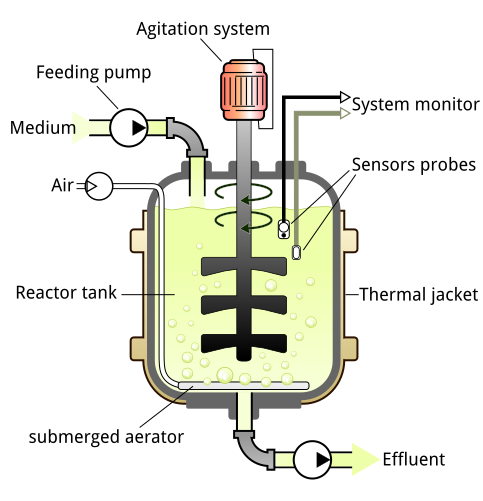
7-10: The diagram shows an industrial fermenter that could be used to grow microorganisms in controlled conditions:
|
YassineMrabet | CC 3.0 | ||||||||||||||||||||
7. Which one of the following organisms could not be grown in this fermenter?
| |||||||||||||||||||||
| 8. The organism and nutrients are placed in the reactor tank. More nutrients can be added through the feeding pump inlet.
Select the correct combination of fermenter part with its function.
| |||||||||||||||||||||
| 9. Which of the following statements is incorrect?
The temperature and pH have to be monitored and regulated because ...
| |||||||||||||||||||||
10. Lactobacillus bacteria are used to make yoghurt. The bacteria ferment the lactose sugar that is in milk. The product formed in lactose fermentation is
| |||||||||||||||||||||

Question 1:
Using the scale in the image, the yeast cells appear to be about 3 µm in length. (Bottom right corner of image).
Correct answer: D
*These A.I. responses have been individually checked to ensure they match the accepted answer, but explanations may still be incorrect. Responses may give guidance but the A.I. might not be able to answer the question! This is particularly the case for questions based on diagrams, which the A.I. typically cannot interpret.
Grade Gorilla uses Gemini, Deepseek and a range of other A.I. chatbots to generate the saved responses. Some answers have had human intervention for clarity or where the A.I. has not been able to answer the question.
Question 2:
Correct answer: C. Fungi
Explanation:
Yeast is a single-celled organism that belongs to the fungi kingdom. Like other fungi, yeast has cell walls made of chitin, is non-photosynthetic, and obtains energy by breaking down organic matter (e.g., sugars) through respiration or fermentation.
The other kingdoms are incorrect because:
A. Plants – Plants are multicellular, photosynthetic, and have cellulose cell walls.
B. Animals – Animals are multicellular, heterotrophic, and lack cell walls.
D. Protoctists – This kingdom includes mostly single-celled organisms like amoeba and algae, but yeast is classified as a fungus, not a protoctist.
*These A.I. responses have been individually checked to ensure they match the accepted answer, but explanations may still be incorrect. Responses may give guidance but the A.I. might not be able to answer the question! This is particularly the case for questions based on diagrams, which the A.I. typically cannot interpret.
Grade Gorilla uses Gemini, Deepseek and a range of other A.I. chatbots to generate the saved responses. Some answers have had human intervention for clarity or where the A.I. has not been able to answer the question.
Question 3:
Yeast ferments sugars in bread dough, releasing carbon dioxide gas as a byproduct.
Carbon dioxide forms bubbles in the dough, causing it to rise.
A. Oxygen → Not released by yeast during fermentation; used in respiration but does not make bread rise.
B. Carbon dioxide ✅ → Released by yeast; causes dough to rise.
C. Water vapour → Produced in small amounts during baking, not the main rising agent.
D. Nitrogen → Not produced by yeast.
✅ Correct answer: B. Carbon dioxide
*These A.I. responses have been individually checked to ensure they match the accepted answer, but explanations may still be incorrect. Responses may give guidance but the A.I. might not be able to answer the question! This is particularly the case for questions based on diagrams, which the A.I. typically cannot interpret.
Grade Gorilla uses Gemini, Deepseek and a range of other A.I. chatbots to generate the saved responses. Some answers have had human intervention for clarity or where the A.I. has not been able to answer the question.
Question 4:
The correct answer is A: Liquid paraffin and Yeast and glucose.
K (Liquid Paraffin): This layer is placed on top of the mixture to prevent oxygen from entering, ensuring the yeast respires anaerobically (fermentation).
L (Yeast and Glucose): This is the active mixture where the yeast feeds on the sugar (glucose) to produce ethanol and carbon dioxide gas.
*These A.I. responses have been individually checked to ensure they match the accepted answer, but explanations may still be incorrect. Responses may give guidance but the A.I. might not be able to answer the question! This is particularly the case for questions based on diagrams, which the A.I. typically cannot interpret.
Grade Gorilla uses Gemini, Deepseek and a range of other A.I. chatbots to generate the saved responses. Some answers have had human intervention for clarity or where the A.I. has not been able to answer the question.
Question 5:
The correct answer is C. Limewater.
Liquid M (Limewater): Limewater is the standard chemical indicator used to test for carbon dioxide. When the gas produced in the first tube bubbles through it, the limewater will turn from clear to cloudy/milky, confirming the presence of carbon dioxide.
*These A.I. responses have been individually checked to ensure they match the accepted answer, but explanations may still be incorrect. Responses may give guidance but the A.I. might not be able to answer the question! This is particularly the case for questions based on diagrams, which the A.I. typically cannot interpret.
Grade Gorilla uses Gemini, Deepseek and a range of other A.I. chatbots to generate the saved responses. Some answers have had human intervention for clarity or where the A.I. has not been able to answer the question.
Question 6:
From the graph, the peak carbon dioxide production is at about 35 °C.
Correct answer: B. 35 °C
*These A.I. responses have been individually checked to ensure they match the accepted answer, but explanations may still be incorrect. Responses may give guidance but the A.I. might not be able to answer the question! This is particularly the case for questions based on diagrams, which the A.I. typically cannot interpret.
Grade Gorilla uses Gemini, Deepseek and a range of other A.I. chatbots to generate the saved responses. Some answers have had human intervention for clarity or where the A.I. has not been able to answer the question.
Question 7:
An industrial fermenter is designed to grow microorganisms under controlled conditions (temperature, pH, oxygen, nutrients).
Most fermenters are used to grow bacteria, yeast, and fungi (like Penicillium) in liquid culture.
A. Bacteria → Can be grown in a fermenter (e.g., for antibiotics or enzymes).
B. Yeast → Can be grown in a fermenter (e.g., for bread, beer, or biofuel production).
C. Algae → Requires light for photosynthesis; a standard industrial fermenter is opaque and has no light source, so algae cannot grow well in it. ✅ Cannot be grown.
D. Penicillium mould → A fungus that can be grown in a fermenter (e.g., to produce penicillin antibiotic).
✅ Correct answer: C. Algae
*These A.I. responses have been individually checked to ensure they match the accepted answer, but explanations may still be incorrect. Responses may give guidance but the A.I. might not be able to answer the question! This is particularly the case for questions based on diagrams, which the A.I. typically cannot interpret.
Grade Gorilla uses Gemini, Deepseek and a range of other A.I. chatbots to generate the saved responses. Some answers have had human intervention for clarity or where the A.I. has not been able to answer the question.
Question 8:
An industrial fermenter has several key parts with specific functions:
Stirring paddles → Mix the contents of the fermenter, keeping nutrients evenly distributed and preventing settling.
Air inlet with filter → Supplies oxygen (for aerobic microorganisms) while preventing unwanted microorganisms from entering.
Thermal jacket → Surrounds the fermenter and keeps it at the required temperature by circulating hot or cold water.
✅ This matches option C.
*These A.I. responses have been individually checked to ensure they match the accepted answer, but explanations may still be incorrect. Responses may give guidance but the A.I. might not be able to answer the question! This is particularly the case for questions based on diagrams, which the A.I. typically cannot interpret.
Grade Gorilla uses Gemini, Deepseek and a range of other A.I. chatbots to generate the saved responses. Some answers have had human intervention for clarity or where the A.I. has not been able to answer the question.
Question 9:
Temperature and pH must be monitored and regulated in a fermenter because microorganisms grow best under optimal conditions.
A. enzymes in micro-organisms work best in optimal conditions → Correct statement (enzymes have optimal temperature and pH).
B. heat is produced due to respiration → Correct statement (respiration is exothermic, so the fermenter can overheat).
C. the contents become more acidic as more and more carbon dioxide is produced → Correct statement (CO₂ dissolves in water to form carbonic acid, lowering pH).
D. the contents become more acidic as more and more carbon dioxide is used up → Incorrect statement. If CO₂ is used up (e.g., by photosynthesis or removed), pH would increase (become less acidic), not more acidic.
✅ Correct answer: D. the contents become more acidic as more and more carbon dioxide is used up
*These A.I. responses have been individually checked to ensure they match the accepted answer, but explanations may still be incorrect. Responses may give guidance but the A.I. might not be able to answer the question! This is particularly the case for questions based on diagrams, which the A.I. typically cannot interpret.
Grade Gorilla uses Gemini, Deepseek and a range of other A.I. chatbots to generate the saved responses. Some answers have had human intervention for clarity or where the A.I. has not been able to answer the question.
Question 10:
Lactobacillus bacteria ferment lactose (the sugar found in milk) to produce energy.
The main product of this fermentation is lactic acid, which causes milk to thicken and sour, forming yoghurt.
A. Glucose → Glucose is a simple sugar, but it is not the main product of lactose fermentation by Lactobacillus (it may be an intermediate, not the final product).
B. Lactose → Lactose is the starting sugar, not a product.
C. Lactic acid ✅ → Produced by Lactobacillus during lactose fermentation; lowers pH and causes milk proteins to coagulate, forming yoghurt.
D. Ethanol → Produced by yeast during alcoholic fermentation, not by Lactobacillus.
✅ Correct answer: C. Lactic acid
*These A.I. responses have been individually checked to ensure they match the accepted answer, but explanations may still be incorrect. Responses may give guidance but the A.I. might not be able to answer the question! This is particularly the case for questions based on diagrams, which the A.I. typically cannot interpret.
Grade Gorilla uses Gemini, Deepseek and a range of other A.I. chatbots to generate the saved responses. Some answers have had human intervention for clarity or where the A.I. has not been able to answer the question.